Accelerate Organizational Growth with ITIL® Maturity
An objective and comprehensive assessment of your organization's service management capabilities (SVS), backed by data and global compliance.
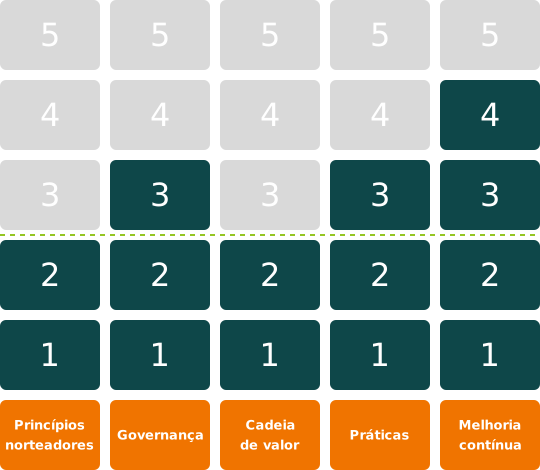
Beyond Theory: Governance That Drives Results
Maturity is the measure of an organization's ability to deliver predictable results, including productivity, quality, compliance, and customer satisfaction.
As an Accredited Consulting Partner (ACP), Amazon Informatica doesn't just apply the official ITIL model; we bring the field experience of large implementations in complex environments, connecting governance to business KPIs (ROA/ROE).
Comprehensive View of SVS
The ITIL Maturity Model assesses all five critical dimensions for value delivery.
Governance
How the organization is directed and controlled.
Guiding Principles
Recommendations that guide the organization in all circumstances.
Practices
Sets of organizational resources designed to perform work.
Service Value Chain
The operating model for creation, delivery, and continuous improvement.
Continual Improvement
The ability to realign services with changing business needs.
Assessment Types
Flexibility to meet your organization's strategic objectives.
Capability Assessment
Assessment focused on one or more specific ITIL practices, without SVS analysis. Ideal for point diagnostics of operational processes.
- Any number of practices
- No SVS assessment
- Not eligible for certification
Maturity Assessment
Assessment of the Service Value System (SVS) combined with up to 6 practices. Continual Improvement is mandatory.
- SVS + up to 6 practices
- Continual Improvement mandatory
- Not eligible for certification
Comprehensive Assessment
Full assessment of the SVS with 7 or more practices (including mandatory Continual Improvement). Only modality eligible for official PeopleCert certification.
- SVS + Practices
- Continual Improvement mandatory
- Eligible for PeopleCert Certification
Scoring Methodology
Understand the logic behind the objective maturity assessment.
The ITIL model distinguishes between Primary (core) Practices and Support Practices, each with a different weight in the final maturity calculation.
Primary Practices
Essential practices that define the organization's core capability. They must achieve the target maturity level.
Support Practices
Auxiliary practices that complement primary ones. They can be up to 2 levels below the target.
Golden Rule
To achieve Maturity Level N, primary practices must be at Level N, and support practices must be at a minimum of Level N-2.
Example: For Level 4 maturity (Quantitative), primary practices must be at Level 4 and support practices at a minimum of Level 2.
The Assessment Process
Structured methodology in 4 official phases.
Scope & Plan
Definition of scope, objectives, schedule, and team mobilization. Alignment of expectations with stakeholders.
Desk Study
Review of existing documentation: policies, procedures, records, and documentary evidence.
Observation
Structured interviews, workshops, and direct observation of practices in operation.
Report & Closure
Consolidation of findings, formal maturity report, and validation session with leadership.
Impact on Business KPIs
Organizations with high IT governance maturity demonstrate a direct correlation with superior financial metrics.
ROA (Return on Assets)
Higher operational efficiency translates into better return on assets.
ROE (Return on Equity)
Solid governance increases investor and stakeholder confidence.
PPE (Profit per Employee)
Mature processes raise individual productivity.
Source: PeopleCert ITIL Maturity Model Research
Why Amazon Informatica?
Proven Practical Experience
We are not just theorists. We have deep experience applying the Maturity Model in complex environments, in both the public and private sectors, ensuring that recommendations are actionable and realistic.
Power up with Auto IMM
Our proprietary solution that automates evidence collection for maturity assessments, reducing manual effort and increasing data accuracy.
Discover the ProductSuccess Case: LatAm Bank
"The assessment gave us a holistic view across the entire business, helping us improve both how we work and what we achieve."
At one of the largest banks in Latin America, Amazon Informatica transformed a landscape of isolated processes into an integrated services ecosystem, raising maturity from "Managed" to "Quantitative" in record time.
The Challenge
Disconnected IT processes, low visibility of compliance, and difficulty in proving value to the business.
The Solution
Implementation of a comprehensive assessment and a improvement roadmap focused on automation and ITIL 4 practices.
Frequently Asked Questions
Clear up your doubts about the ITIL Maturity Model.
What do I receive at the end of the assessment?
You receive three main deliverables: (1) A Detailed Assessment Report with objective scoring and identified gaps; (2) A prioritized Improvement Roadmap based on risk and business value; (3) A formal Validation Session with leadership to align on next steps.
How long does a full assessment take?
The duration varies by scope. A typical Capability Assessment takes 2 to 4 weeks. A full Comprehensive Assessment can take 6 to 12 weeks, depending on the number of practices and team availability.
Is certification really necessary?
PeopleCert certification is not mandatory but offers globally recognized external validation. It demonstrates to stakeholders, clients, and regulators that your organization follows international IT governance standards. The certification is valid for 3 years.
How should I prepare for the assessment?
We recommend: (1) Appointing an executive sponsor and a technical point of contact; (2) Gathering existing process documentation; (3) Aligning expectations with the teams to be interviewed; (4) Defining which practices will be prioritized in the initial scope.
What is Converge Auto IMM?
Auto IMM is our proprietary solution that automates evidence collection directly from your ITSM tools (ServiceNow, Jira, etc.). This significantly reduces manual effort, accelerates the assessment lifecycle, and increases the accuracy of collected data.
What is the difference between Maturity and Capability?
The Capability Assessment focuses exclusively on specific practices without analyzing the SVS. The Maturity Assessment includes the SVS and up to 6 practices, but is not eligible for certification. Only the Comprehensive Assessment (SVS + 7 or more practices) is eligible for official certification.
Discover your IT maturity level
Ready to evolve?